
In the realm of high-end horology, energy management in mechanical watchmaking is not merely a resource—it is a closed system. Precision, reliability, and long-term chronometric performance are direct consequences of how energy is generated, stored, transmitted, and regulated. From a technical standpoint, the evolution of energy management mechanisms has been the defining factor behind the most significant breakthroughs in modern movement architecture.
This article explores the transition from traditional power storage to intelligent energy management, focusing on torque stability and mechanical efficiency.
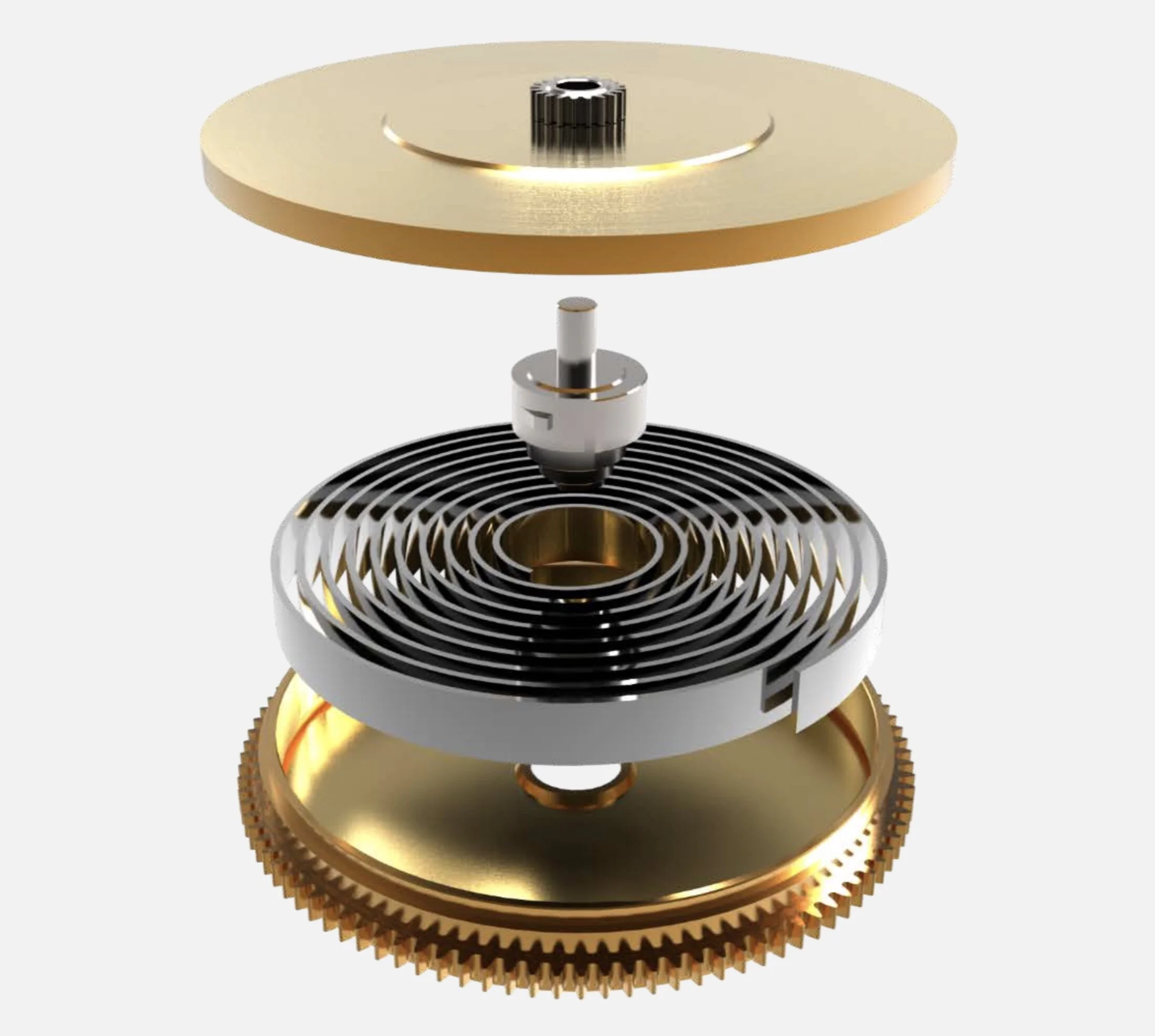
The Barrel Assembly: From Passive Reservoir to Strategic Component
Historically, the mainspring barrel was treated as a passive container. Modern horological engineering has transformed it into a dynamic element that dictates the movement’s rate stability.
• Advanced Mainspring Metallurgy: Contemporary mainsprings utilize Nivaflex-based alloys and cobalt-chrome compositions that offer flatter torque curves and superior fatigue resistance. These alloys allow for extended power reserves (72h to 10-day calibers) without the traditional “power drop-off” that compromises isochronism.
• Modular Barrel Architectures:
• Series Configuration: Aimed at increasing autonomy by summing the rotation of multiple drums.
• Parallel Configuration: Aimed at increasing torque (Nm) to maintain high-frequency balance wheels or drive complex complications without amplitude loss.
• Efficiency Optimizations: The integration of ball-bearing mounted barrels and “coverless” designs reduces vertical play and parasitic friction, ensuring a more linear transmission of force to the center wheel.
Torque Management: The Pursuit of Constant Force
The non-linear discharge of a mainspring remains the primary enemy of isochronism. A professional watchmaker understands that regulating a movement is futile if the torque delivered to the escapement is inconsistent.
• Constant-Force Systems: Solutions like the Fusée-and-chain continue to be the gold standard for mechanical compensation, using a cone-shaped pulley to equalize torque. However, we are seeing a resurgence of the Remontoire d’égalité—a secondary short-term spring that recharges at fixed intervals (e.g., every second), effectively isolating the escapement from the mainspring’s declining force.
• Direct-Impulse Escapements: New geometries, such as the Grand Seiko Dual Impulse or the Omega Co-Axial, are designed to minimize energy dissipation during the locking and unlocking phases, making the system less sensitive to slight torque fluctuations.
Transmission Efficiency and Friction Reduction
The future of the “mechanical heart” lies not in generating more power, but in wasting less. We are moving toward a “low-friction” philosophy.
• High-Tech Materials: The use of silicon (Elinvar/Silinvar) and LIGA-fabricated nickel-phosphorus parts has revolutionized the pallet fork and escape wheel. These components are antimagnetic, lightweight (lower inertia), and require zero lubrication, drastically reducing energy loss.
• Surface Engineering: Diamond-Like Carbon (DLC) coatings on pivots and optimized cycloidal gear tooth profiles ensure that the energy produced in the barrel reaches the balance wheel with over 90% efficiency, compared to the 60–70% seen in vintage calibers.
Automatic Winding: Optimized Energy Harvesting
The automatic caliber has evolved from a simple oscillating weight to a highly sophisticated energy acquisition system.
• Rotor Topologies: The shift toward peripheral rotors and micro-rotors is no longer just aesthetic. These designs optimize the movement’s center of gravity and reduce the load on the winding bridges.
• Reduction Gear Efficiency: Modern ceramic ball bearings for rotors and bidirectional “Magic Lever” or “Pellaton” evolved systems have reduced the “dead angle” of winding, allowing the watch to reach its maximum state of charge even with sedentary user behavior.
Future Trends: The Era of Energy-Conscious Horology
The next decade will see a transition toward “Intelligent Mechanical Architecture.” We are moving beyond the 4Hz standard toward systems that manage energy with surgical precision.
• Integrated Torque Management Modules: Future calibers will likely feature built-in differential systems that automatically decouple the barrel when torque falls below a specific chronometric threshold (power reserve shut-off).
• Virtual Simulation & Digital Twins: The use of FEA (Finite Element Analysis) in the design phase allows watchmakers to calculate the exact friction coefficient of every tooth and pivot, creating movements that can run for 10+ years without a significant drop in amplitude.
• Monolithic Regulators: Emerging compliant mechanisms (like the Zenith Oscillator) eliminate the need for traditional hairsprings and palettes, reducing the number of parts and, consequently, the energy required to maintain oscillation.
Conclusion: Energy as a Design Philosophy
A well-conceived mechanical watch is not defined by its complexity, but by the intelligence with which it manages its energy budget. As professional watchmakers, our responsibility extends beyond mere repair; we must master the flow of energy from the arbor to the impulse pin.
Understanding the physics of energy transmission is what ensures that mechanical watchmaking remains not a relic of the past, but a peak of engineering for the future.